9 Case Interview Mistakes That Cost Offers (and the Fix for Each)
The case interview mistakes that actually sink candidates — from recited frameworks to silent math to answering the wrong question — and a concrete fix for every one.
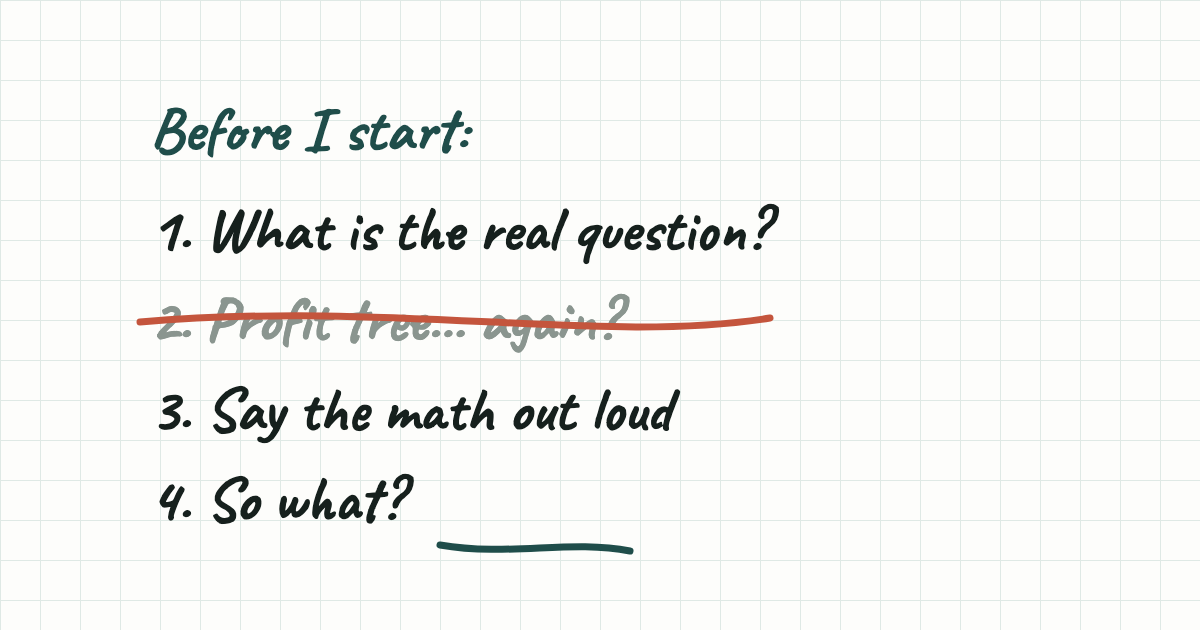
Most case interview advice tells you what to do. This is the inverse: the mistakes that reliably sink otherwise-strong candidates, in rough order of damage, each with the fix. If your mocks are scored, you'll recognize your own top two — every candidate has a signature pair.
1. Solving the wrong problem
The most expensive mistake there is: a flawless analysis of a question that wasn't asked. The client asked whether to enter the market; you spent 25 minutes optimizing their pricing. Fix: restate the objective in your own words before structuring — "So success here means deciding whether to launch, and the bar is profitability within three years?" — and check back against it at every transition.
2. Reciting a framework instead of building one
"This is a profitability case, so I'll look at revenues and costs" tells the interviewer you've memorized a casebook, which was not the question. Generic structures score poorly at top firms and collapse at the first "why?". Fix: build the structure from the case's own language — 3–4 drivers, each with a one-clause justification. Full method in our frameworks guide.
3. Doing math silently
Thirty seconds of scribbling in silence is thirty seconds where the interviewer can't follow you, can't credit you, and can't rescue you from a slip they saw coming. Fix: narrate every calculation — the setup before the numbers, the numbers as you go, the sanity check at the end. It's a separate skill from arithmetic; drill it as one (our case math routine).
4. Describing exhibits instead of concluding
Reading the bars aloud is a book report. The exhibit exists to change the answer. Fix: never leave a chart without a "which means..." — insight, number, implication, next step. The four-step method is in our exhibits guide.
5. Ignoring the interviewer's hints
Case interviews are cooperative, and interviewers steer: "Interesting — what about the cost side?" is not small talk, it's a lifeline. Candidates in execution mode plow past these regularly. Fix: treat every interviewer interjection as signal. If they redirect you, go — gracefully and immediately, not after finishing your paragraph.
6. Hiding from the numbers
Waiting to be handed the math, hedging every estimate, or presenting a range so wide it says nothing. Consulting is a quantitative job and the interview checks appetite, not just ability. Fix: volunteer the calculation. "Can I try to size that?" is one of the strongest sentences a candidate can say.
7. The confidence miscalibration — both directions
Steamrolling past pushback reads as uncoachable; folding instantly ("you're right, sorry, let me start over") reads as having no spine. Interviewers push back on correct answers specifically to test this. Fix: defend with reasons, concede to evidence. "I'd stick with my estimate because X — but if the data shows Y, that changes the picture" passes both tests in one sentence.
8. Ending without a recommendation
Trailing off with "so... those are the main considerations" after 25 minutes of analysis. The case was a decision; the client is in the doorway asking what to do. Fix: rehearse the closing shape until it's reflexive — answer first ("I recommend entering"), two or three supporting reasons with numbers from this case, one risk with its mitigation. Delivered in about a minute, unprompted.
9. Practicing everything silently, then performing live
The meta-mistake that produces most of the others. Reading casebooks trains recognition; interviews grade performance — speaking, computing, and reacting under observation. Candidates who only studied silently routinely discover in the real room that they've trained the wrong skill. Fix: make most of your prep spoken and observed — a partner, a coach, or an AI interviewer. A scored mock (this is what Key Takeaways does — full case, live video, breakdown skill by skill, from structuring and quant to communication) also tells you which of these nine is your signature mistake, which is worth more than ten unscored reps.
The bottom line
Nobody eliminates all nine — offers go to candidates whose mistakes are small, caught, and recovered. Find your top two, point a week of drills at them, and re-test in a live mock. That loop, repeated, is the whole prep.
Ready to practice out loud?
Run a full spoken mock case with a live AI interviewer and get a scored breakdown at the end. Every account starts with 2 free cases.